
Why Does a Custom Dress Cost More Than One Online?
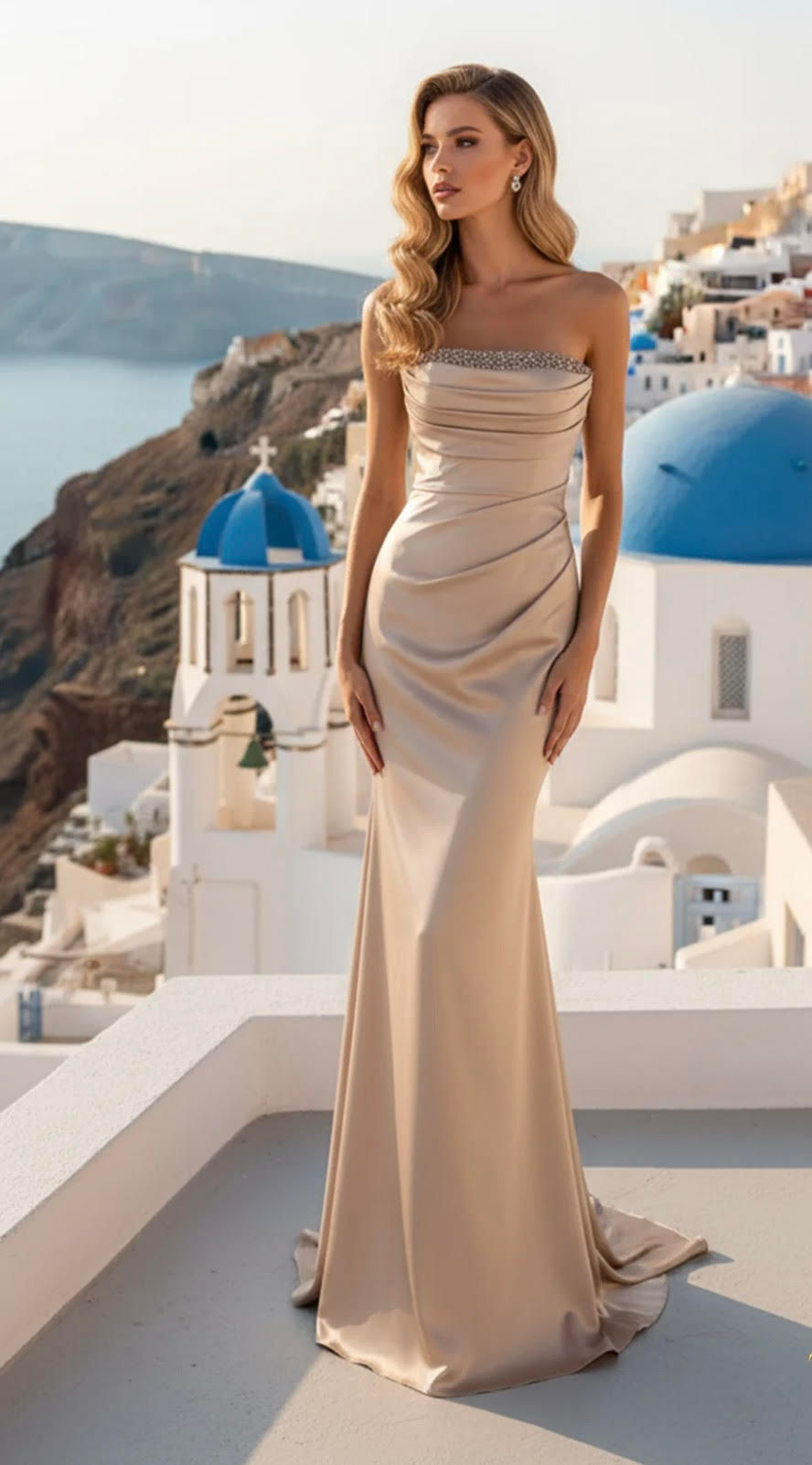
A mother of the bride recently reached out to us for a quote on a dress she found online. She sent photos of the dress along with the changes she wanted and her usual sizes. The dress was beautiful!
To ensure we constructed it correctly, we needed to confirm a few details, such as her bra cup size. This information was crucial for determining how much internal support the dress would need in the bust area.
It was also helpful to know her height, approximate weight, and body proportions, such as whether she had a smaller waist or fuller hips. This information helped us better understand her body shape and how to tailor the dress for a perfect fit.
She mentioned that she was losing weight and that her bra size had changed from 12DD to a 10-12 E or F, depending on the brand.
The cost to replicate the dress she wanted was AU$4,800 plus GST (approx. US$3,200). However, she expected to pay no more than AU$1,000 (US$663) for a custom-made dress in Australia. She felt the price was too high and was puzzled as to how she could find a similar dress online for only AU$670 (US$444). As she sought my help in understanding why a dress made to measure in Australia was more expensive than one purchased online from overseas, I emailed her. This inspired me to write this blog post to help others with similar questions.
Firstly, I completely understand why the price surprised her. I primarily work with wedding dress alterations in Melbourne, and depending on the changes customers want, these alterations can be expensive when compared to what they paid for their wedding dress.
Thus, I would like to explain the differences between custom-made dresses and those purchased online. Once the breakdown is provided, the question often shifts from “Why is a custom-made dress so expensive?” to “How can people work under such poor conditions?”
1. Breakdown of Costs for a Custom-Made Dress
To give you a clearer idea, here is the cost breakdown for reproducing a dress like the one in the picture (all prices are in Australian Dollars).
1.1. Cost of Fabrics and Materials in Australia
The dress she chose requires a substantial amount of fabric due to the pleats and the necessity to cut on the straight grain for the best finish. The materials alone can cost more than the dress.
Item | Quantity and Unit Cost | Total Cost in Silk | Total Cost in Polyester | Reference |
Main Fabric - Silk Crepe Satin | 4 meters × $139.70 | $558.80 |
| |
Lining - Silk Habotai | 4 meters × $48.40 | $193.60 | ||
Main Fabric & Lining - Polyester Toscano | 8 meters × $58.95 |
| $471.60 | |
Calico for Mock-Up (Toile) | 4 meters × $11.00 | $44.00 | $44.00 | |
Medium Woven Interfacing | 1 meter × $4.50 | $4.50 | $4.50 | |
Fusible Interfacing | 1 meter × $20.00 | $20.00 | $20.00 | |
Boning 12mm for Internal Structure | 3 meters × $2.99 | $8.97 | $8.97 | |
Invisible Zip & Hook and Eye |
| $16.50 | $16.50 |
|
Sourcing materials from different suppliers | 3 hours + petrol cost | $100.00 | $100.00 |
|
| TOTAL MATERIALS | $946.37 | $665.57 |
|
1.2. Custom Dress Patternmaking and Construction Labour
A custom dress is tailored specifically to your body measurements. With formal training as a professional fashion designer, including a three-year degree in Fashion Design from my home country, a specialisation in corsetry in Melbourne, and further specialisation in patternmaking in Spain, I bring more than 20 years of experience in the fashion industry to my work. This expertise allows me to create garments of the highest quality.
Given that she has a fuller bust (E-F cup), the dress requires an internal corset with additional boning and support. Below is a breakdown of the activities involved:
Measurement appointment
Drafting your pattern from scratch
Cutting and sewing the mock-up
First mock-up fitting
Adjusting the pattern and mock-up
Second mock-up fitting
Cutting and sewing the final dress, including the full internal structure
First fitting of the final dress
Final finishing touches
Total patternmaking and construction: $3,840.00
Note that this total does not include any additional fittings if the weight changes before the event (which is quite common), or any last-minute design alterations that clients often request.
1.3. Behind the Seams: Atelier Overheads Explained
In addition to the materials and labour costs already mentioned, there are ongoing business expenses that enable any atelier to work professionally. Some of these costs include:
Rent or mortgage for studio space
Utilities beyond electricity
Sewing machine servicing and repairs
Specialist equipment (overlockers, industrial irons, mannequins, pressing tools)
Consumables (pattern paper, threads, needles, pins, chalk, rulers, cutting mats)
Insurance (public liability, contents, professional indemnity)
Software licenses and client communication tools
Website hosting, photography, social media ads
Accounting and bookkeeping fees
Taxes & GST compliance costs
The total cost for materials and labour (from points # 1 and 2) amounts to $4,786.37 plus GST for the silk option, excluding the above Studio expenses, which is in line with the quoted price of $4,800.
2. How Factory-Made Dresses Are Produced?
The reason you can find a dress online for AU$670 is that the production process in large factories is fundamentally different from custom dressmaking. Here is an outline of how online dresses are typically made (prices are in Australian dollars):
2.1. Materials Are Purchased Extremely Cheaply
Factories buy fabric, zippers, thread, and boning in massive quantities, sometimes by the container. Due to this bulk purchasing, the actual cost of all materials for one dress often ranges from $15 to $20. These materials are usually synthetic and of much lower quality compared to those used in custom dressmaking.
2.2. The Pattern Is Not Made for an Individual Body
Instead of creating a pattern based on the client’s measurements, factories create a standard pattern based on a mannequin (usually a size 10, which does not accurately represent real body proportions). This pattern is then digitally scaled up or down to create all the other sizes. As a result, the shape is never truly tailored to any individual's body, which is why online dresses often require significant alterations upon arrival.
2.3. Cutting Is Done in Large Stacks, Not One Dress at a Time
Once the pattern is ready, it goes to the cutting department. In factories, the fabric is laid out in long layers, sometimes 20 cm or more thick, allowing dozens or even hundreds of dresses to be cut at once. The pattern is placed on the top layer, and a large electric cutter slices through all the layers at once. While this method is high-speed, the precision is lower; pieces may shift during cutting, resulting in variations among the individual pieces.
2.4. Sewing is Done by Assembly-Line Machinists
After cutting, all the pieces move to the sewing line. Most factory workers are not trained seamstresses, dressmakers, or designers; they are machinists who perform only one task all day. For example:
One person sews only the side seams
One person attaches only the zippers
One person works on only the hems
One person adds only boning
One person attaches only the straps
Each worker repeats the same step hundreds of times a day. While this system allows for fast production, it has drawbacks:
A trained professional doesn't check the dress
Quality can vary
Workers do not make any adjustments for fit or support
Inner structures are minimal or often missing
Experienced garment machinists in developing countries like Bangladesh, Vietnam, and India earn relatively low wages, ranging from approximately $170 to $650 per month. In comparison, China, as it shifts from a "developing" to a "high-income" country, offers the highest salaries for these workers, averaging around $1,800 per month, which is modest compared to Australian standards.
2.5. No Fittings, No Adjustments, No Customisation
Since factory dresses are mass-produced, they are never fitted to a real person. No mock-up is created, and no alterations are built into the original construction. Extra support for larger cup sizes or different body shapes is not included. The dress is made exactly once, based on a scaled pattern, in the most cost-efficient way possible.
2.6. The Final Price Includes Marketing, Not Labour
Online shops add a margin for:
Profit
Advertising
Photography
Website costs
Even with these added expenses, the total price remains low because the actual labour and material costs are minimal.
2.7. The Reality of Working Conditions
It's important to understand that the low price of mass-produced dresses is possible only because the machinists who make them are paid extremely low wages. Most of these workers live in poor and difficult conditions, often earning so little that they struggle to cover basic needs such as:
Safe housing
Adequate food
Medical care
Education for their children
These factories operate in countries where labour rights and protections are limited, and the workers lack the power to demand better conditions. Their living standards are a world apart from what we are accustomed to in Australia. This situation leads people in wealthier countries to believe that high-quality garments can be produced at impossibly low prices. Unfortunately, those low prices are only feasible because the workers are denied the dignity and equality that should be the foundation of fair work. Cheap fashion should never come at the cost of human dignity, because no garment is truly beautiful if it’s stitched with exploitation.
3. What’s the True Cost Behind Factory Prices?
It's important to recognise that in mass production, the primary beneficiaries are the factory owners. Even when we take a generous view, the true production cost of the dresses we usually find online at ridiculous prices often ranges between $100 and $150. This figure includes the costs of fabric, labour, and overheads. The remainder of the retail price typically becomes profit for the factory and the retailer. This disparity explains why garments might look appealing in photos but often arrive with limited structure, minimal support, subpar materials, and various quality issues. The low price does not reflect the work's true value; rather, it highlights the corners that must be cut to sell at that cost.
4. The Value of the Fashion Profession
It is interesting how frequently the work involved in fashion design and dressmaking is underestimated. People tend to place great value on professions like doctors, lawyers, and accountants (rightly so, as these roles are essential). However, clothing professionals also play a crucial role in daily life. We create the garments that everyone, including doctors and lawyers, depends on to present themselves professionally and comfortably. Clothing is not optional; it is a necessity. Regardless of profession, no one goes to work without wearing something designed and constructed by someone in our field.
In summary, a custom-made dress includes:
Premium fabrics and materials
Unique patternmaking
Internal structure and support
Multiple fittings and adjustments
Skilled labour and professional expertise
The price of a custom dress reflects its quality, ethical production practices, and the knowledge, experience, and time dedicated to creating something truly unique. I hope this explanation clarifies the difference between a custom dress and a mass-produced garment.
I also recommend watching the investigative documentary The True Cost: Who Pays the Real Price for Your Clothes, which highlights the reality of fast-fashion production and the true cost of low-priced clothing.
Sandra Flechas
SEAMWORKS
Comments